This post may contain affiliate links, which means I may receive a small commission should you decide to click that link and make a purchase. For more information please refer to the Terms & Conditions.
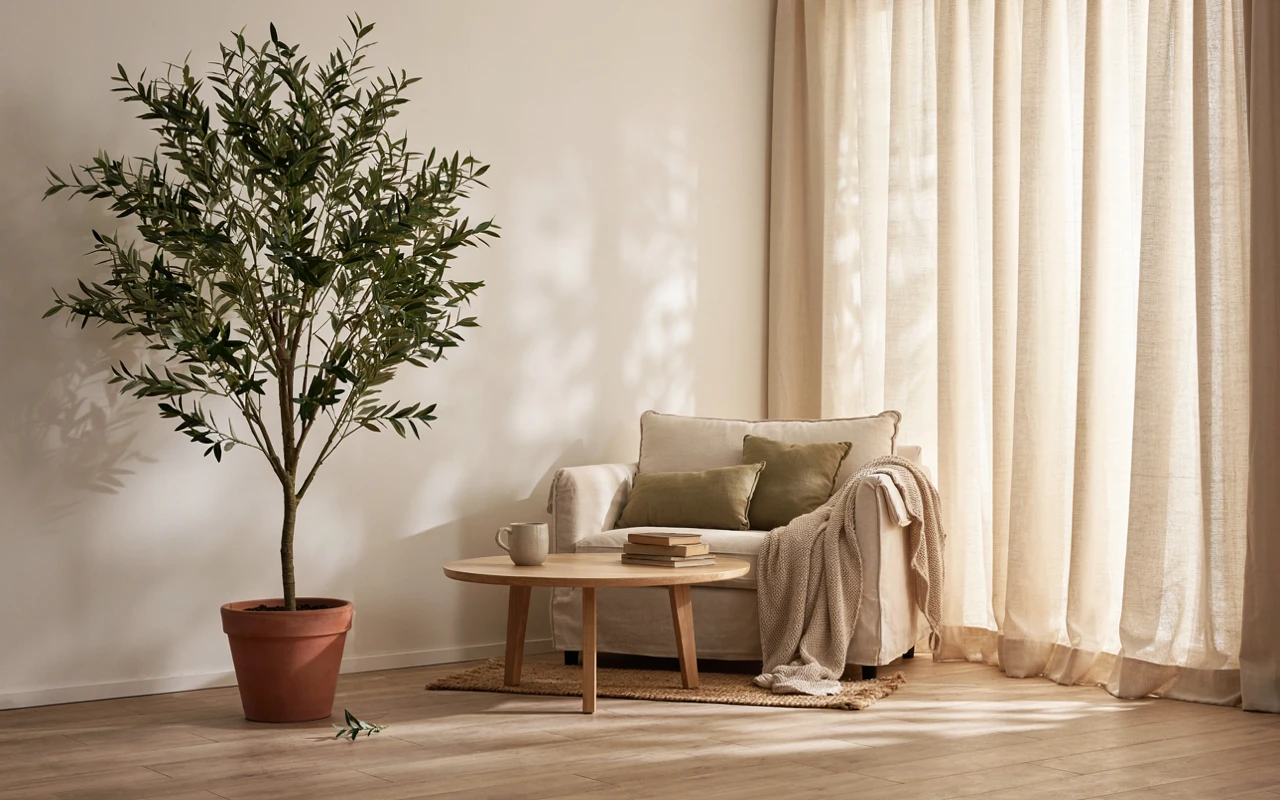
The first time I saw an olive tree in a living room, it was at a friend’s apartment, tucked beside a big window with the afternoon sun shining through its silvery leaves. I went home that night already planning my own olive tree living room, because I wanted that same fresh and natural look without redoing the whole room.
It took me a few tries to get it right. My first tree dropped half its leaves in a month because I put it in a dim corner where it looked nice but couldn’t grow.
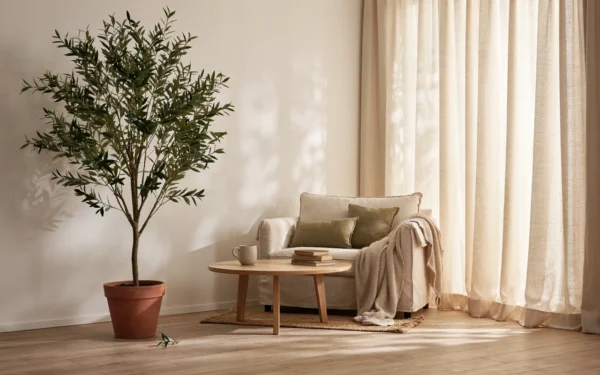
These days, my olive tree is the first thing people notice when they walk in. It goes with almost any furniture, it softens hard corners, and it makes the whole room feel lighter.
Below, you’ll find 11 easy ideas for bringing an olive tree into your living room for a fresh and natural look, whether you have a sunny bay window or a room that barely sees daylight.
1. Give Your Indoor Olive Tree the Sunniest Window
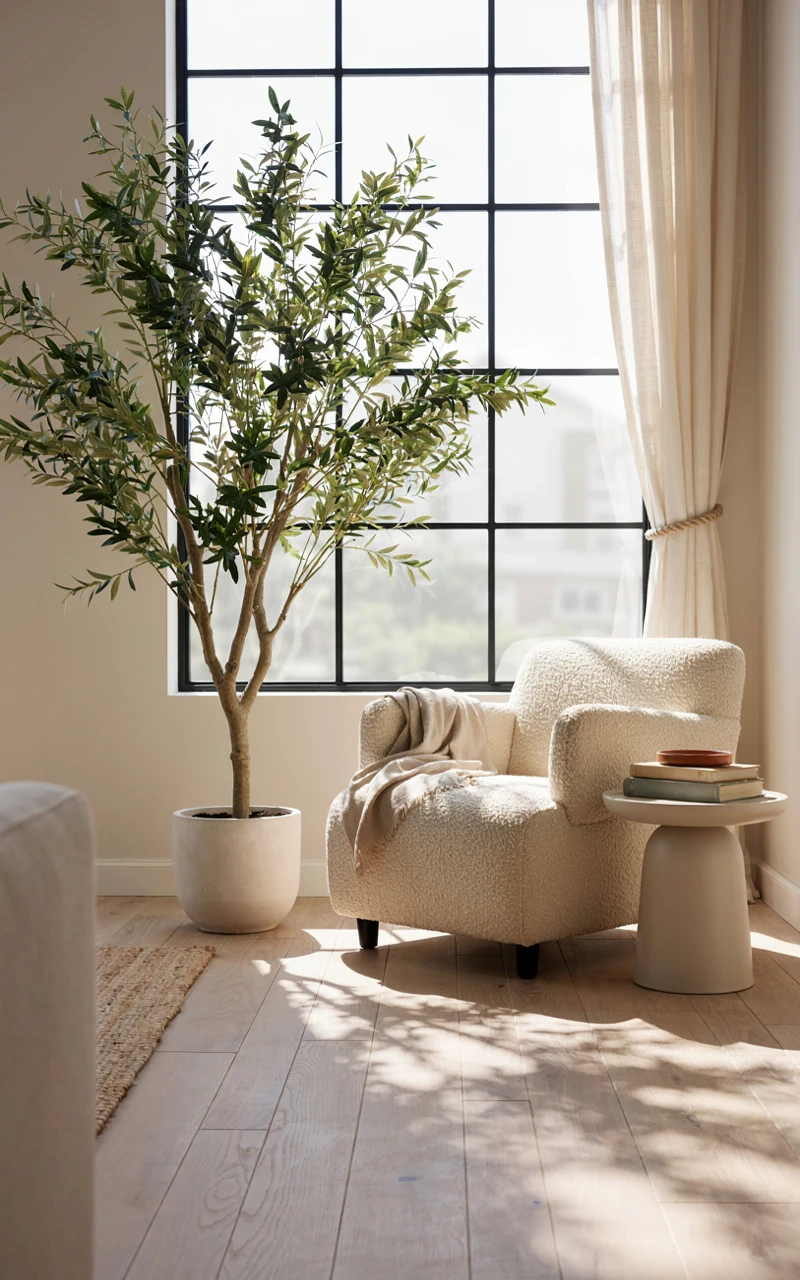
If you only take one tip from this list, make it this one. An indoor olive tree needs more sun than most houseplants, and the window you pick decides whether it thrives or slowly drops its leaves.
Olive trees come from the Mediterranean, where summers are long, hot, and bright. Britannica’s guide to the olive describes a tree built for dry, sunny places, so aim for at least six hours of direct sun a day. In most US homes, that means a south-facing window, with west-facing as a close second.
| Window direction | How much sun | Good for an olive tree? |
|---|---|---|
| South | Bright, direct sun most of the day | Best choice |
| West | Strong afternoon sun | Very good |
| East | Gentle morning sun | Okay, but add a grow light in winter |
| North | Soft, indirect light | Not enough on its own |
Once your tree is in place, a few small habits keep it happy:
- Turn the pot a quarter turn every week or two so all sides get sun and the tree grows straight.
- Water only when the top 2 inches (5 cm) of soil feel dry, then water until it drains out the bottom.
- Keep it at least 3 feet (90 cm) away from heating vents and radiators, which dry out the leaves.
- Wipe the window glass now and then, since a dusty window cuts more light than you’d think.
In summer, your tree will love a few months outside on a sunny patio. If you’re already working through some cozy backyard ideas, a potted olive tree out there from June to September gives it a real boost before it comes back in for fall.
Key takeaway: Sun comes first. Pick the window, then build the rest of the living room around the tree.
2. Fill an Empty Corner With a Tall Olive Tree
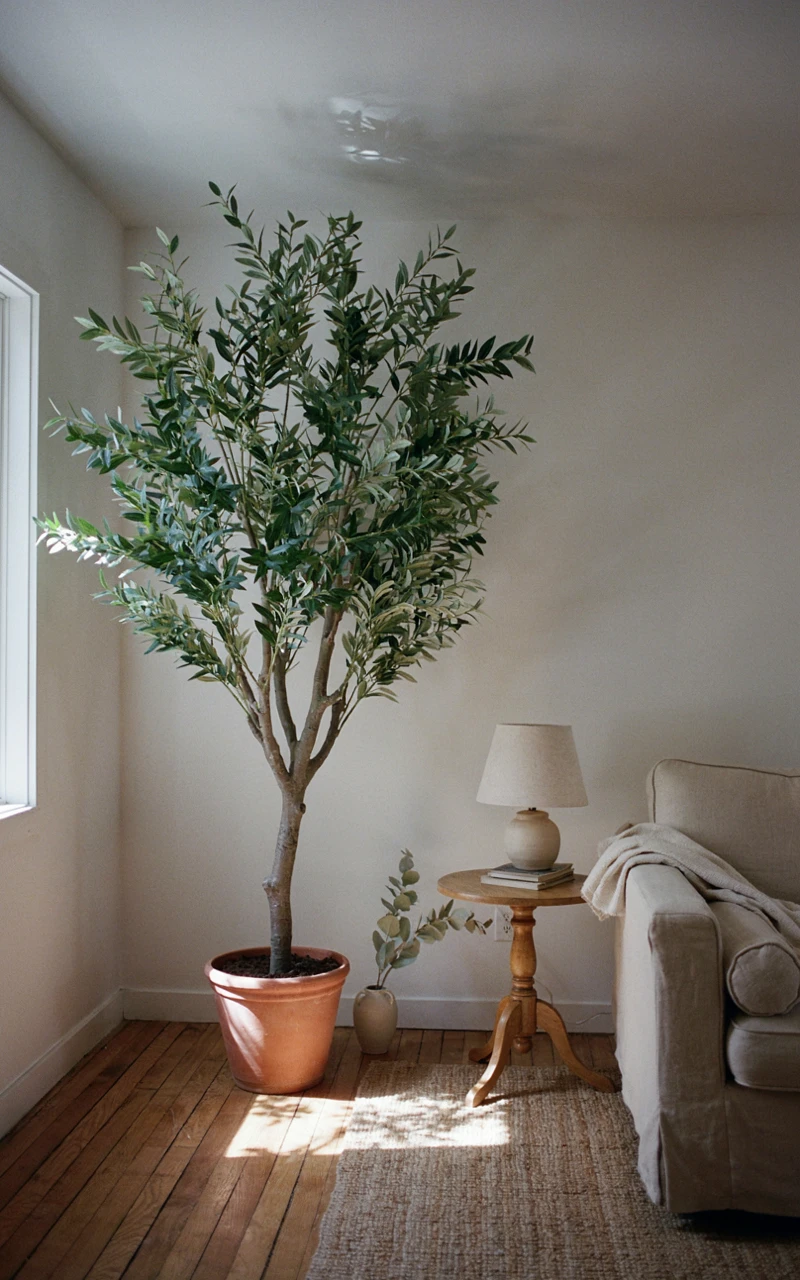
Almost every living room has that one awkward corner. Maybe it’s too small for a chair, or a side table there just looks lonely.
A tall olive tree fixes that in one move. Its thin trunk takes up very little floor, while the leafy top fills the empty wall above. It’s one of my favorite kinds of tree decor in a living room because it adds height without making the room feel crowded.
For a corner, look for a tree between 5 and 6 feet (1.5 to 1.8 m) tall, including the pot. Leave at least 12 inches (30 cm) between the top leaves and the ceiling so it doesn’t look squished, and so it has room to grow.
Here’s how to make the corner work:
- Choose a corner near a window. A corner right beside a sunny window is ideal. A dark back corner is better saved for a faux tree (see idea 7).
- Pull it out from the wall. Set the pot 6 to 8 inches (15 to 20 cm) away from both walls so the branches can spread naturally.
- Add a low stool or plant stand if your tree is short. A sturdy wooden stand can add a foot of height to a smaller tree.
- Keep the corner simple. Skip extra pots and knickknacks around the base so the tree stands out on its own.
If you want a fuller look, ask your garden center for a “multi-stem” olive tree, which has several trunks growing from one pot. A “standard” olive tree has one straight trunk and a rounded top, and it looks a little more polished and tidy. Both work well in a corner, so go with whichever shape you like best.
Key takeaway: A tall, slim olive tree turns a dead corner into the part of the living room people actually look at.
3. Plant It in a Terracotta Pot for Earthy Warmth
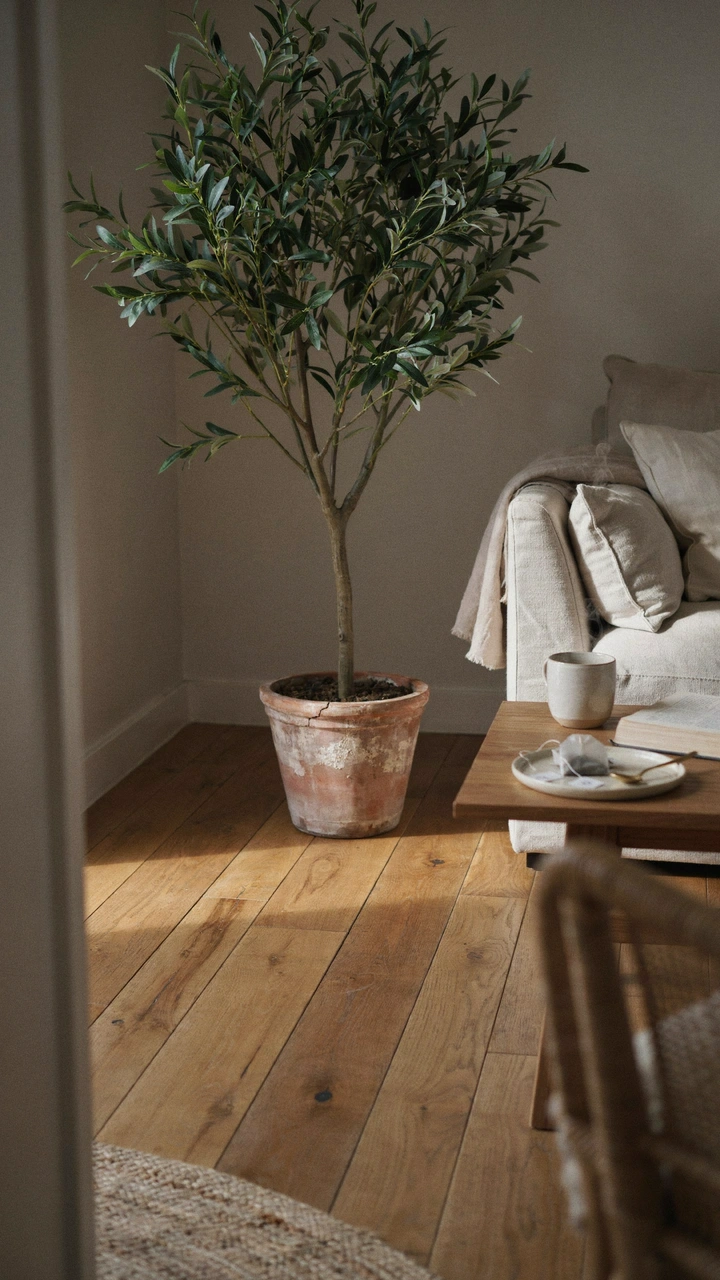
Terracotta and olive trees just belong together. The warm, clay-orange color looks like something you’d see on a sunny Greek terrace, and it makes silvery green leaves pop.
There’s a practical reason, too. Terracotta is porous, so it lets air and water move through the walls of the pot. Olive trees hate sitting in wet soil, and a clay pot helps the soil dry out between waterings, which lowers the chance of root rot.
When you pick a terracotta pot, keep these points in mind:
- Make sure it has a drainage hole. No hole means water pools at the bottom and rots the roots.
- Choose a pot about 2 inches (5 cm) wider than the root ball. Too big a pot holds too much wet soil.
- Set it on a saucer with cork or felt pads underneath to protect your floor, since clay can sweat a little.
- Fill it with a fast-draining mix, like cactus soil mixed with a few handfuls of perlite or fine gravel.
This chart gives you a rough idea of what pot size suits your tree:
| Tree height | Pot width |
|---|---|
| Under 2 feet (60 cm) | 6 to 8 inches (15 to 20 cm) |
| 2 to 4 feet (60 to 120 cm) | 10 to 12 inches (25 to 30 cm) |
| 4 to 6 feet (1.2 to 1.8 m) | 14 to 18 inches (35 to 45 cm) |
A tall tree in a heavy clay pot is also less likely to tip over if a dog or a toddler bumps into it. If the bright orange feels like too much for your room, look for a washed or whitewashed terracotta. It has the same benefits with a softer, chalky color.
Key takeaway: A terracotta pot looks warm and earthy, and it keeps your olive tree’s roots dry and healthy.
4. Swap the Pot for a Woven Basket Planter
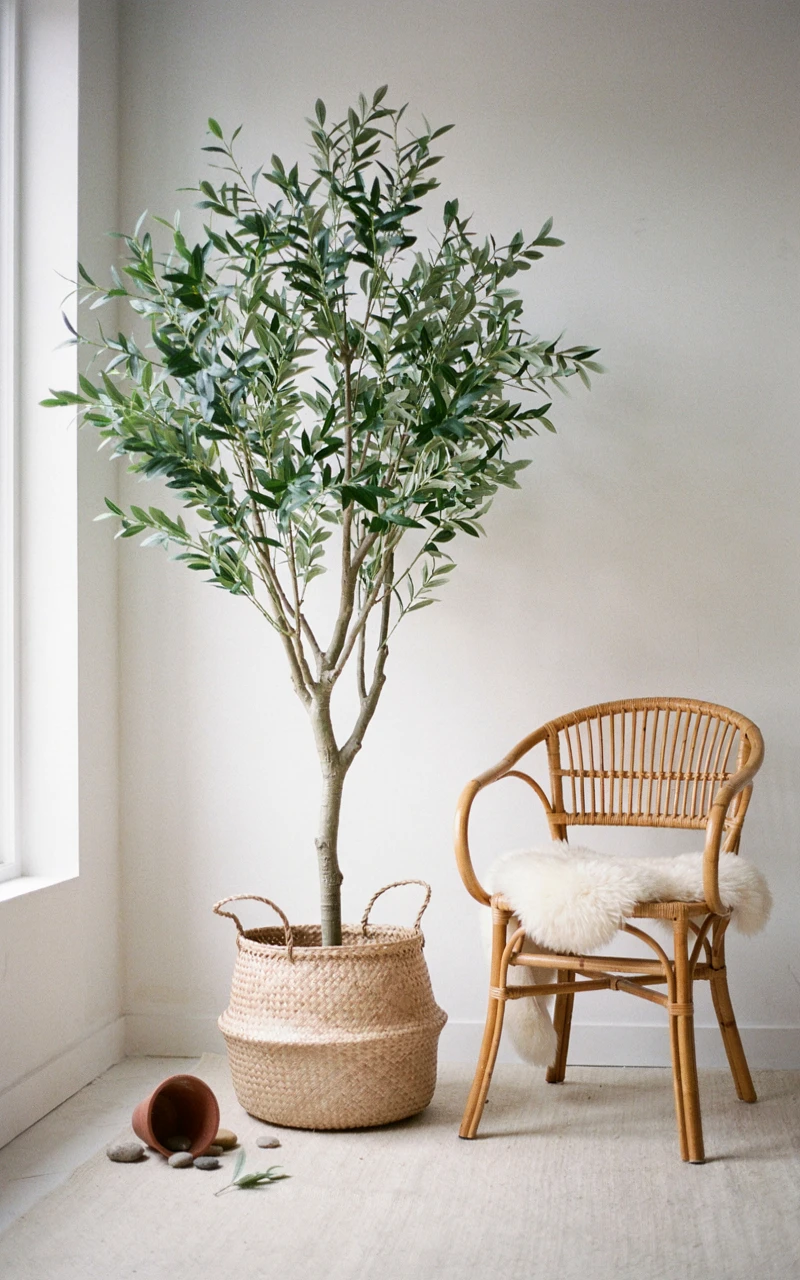
If your living room leans relaxed and beachy, a woven basket might suit your olive tree better than a pot. Seagrass, rattan, and jute baskets add a soft, handmade feel that looks lovely next to the tree’s gray-green leaves.
The catch is that a basket isn’t really a planter. It can’t hold soil or water on its own, and wet soil sitting against woven fibers will stain and rot them. So think of the basket as a cover, not the actual home for the roots.
Here’s the easy way to set it up:
- Keep your olive tree in the plastic nursery pot it came in, as long as that pot has drainage holes.
- Pick a basket that’s 2 to 3 inches (5 to 8 cm) wider than the nursery pot.
- Place a plastic saucer or tray in the bottom of the basket to catch extra water.
- Lower the potted tree onto the saucer inside the basket.
- Tuck a handful of sheet moss on top to hide the plastic rim.
When it’s time to water, lift the nursery pot out, water it in the sink or tub, let it drain for 15 minutes, and then pop it back in. It sounds fussy, but it takes less than five minutes and keeps the basket looking new for years.
Baskets with handles are especially handy, because you can carry the whole thing to a sunnier spot. A basket with a tight, chunky weave also hides the plastic pot better than a loose, open weave does.
Key takeaway: A woven basket gives your olive tree a soft, relaxed look. Just keep the real pot inside it and the water away from the fibers.
5. Flank the Fireplace With Two Matching Olive Trees
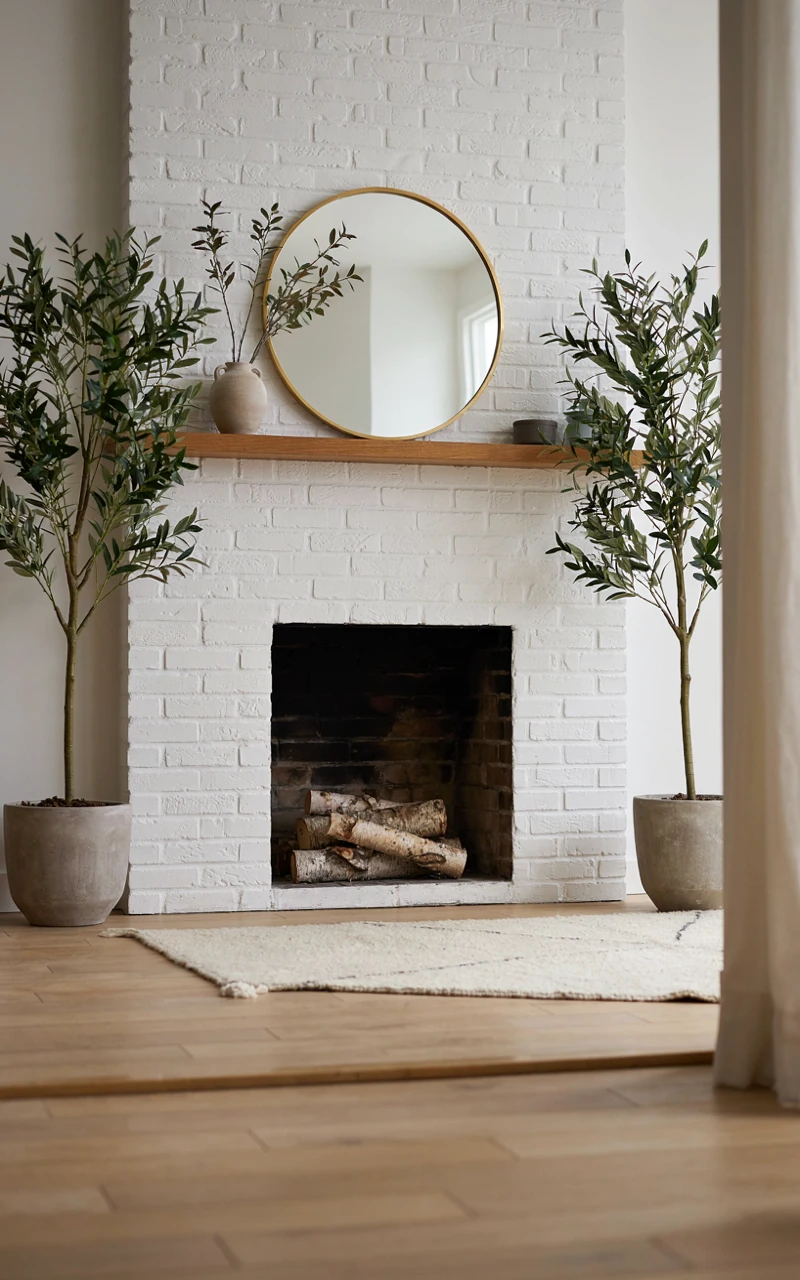
If you have a fireplace, two olive trees on either side of it look classic and balanced. Matching pairs draw the eye to the center of the room, and the fireplace suddenly feels like the anchor it’s supposed to be.
The trick is making them really match. Buy both trees at the same time from the same place, so they start out close in height and shape. Use two identical pots, too, because mismatched pots make the pair look accidental.
Before you set them up, think about heat and light:
- Heat: If you use your fireplace, keep each tree at least 3 feet (90 cm) from the firebox. Dry, hot air will crisp up the leaves fast.
- Light: Fireplaces are often on walls without windows. If yours gets little sun, either rotate the trees to a window for a few days each week or go with a faux pair.
- Even growth: Turn both trees on the same day so one doesn’t lean toward the light while the other grows straight.
Trees grow at their own pace, so one might shoot ahead after a few months. A light trim in late winter or early spring brings them back in line. Snip just above a pair of leaves, and new growth will sprout from that spot.
Olive trees look especially good against a painted fireplace wall. If you’ve been curious about color drenching, a soft cream, warm white, or muted clay color behind the trees makes the silvery leaves stand out beautifully.
Key takeaway: Two matching olive trees by the fireplace give your living room an easy, balanced focal point.
6. Set a Small Olive Tree on the Coffee Table
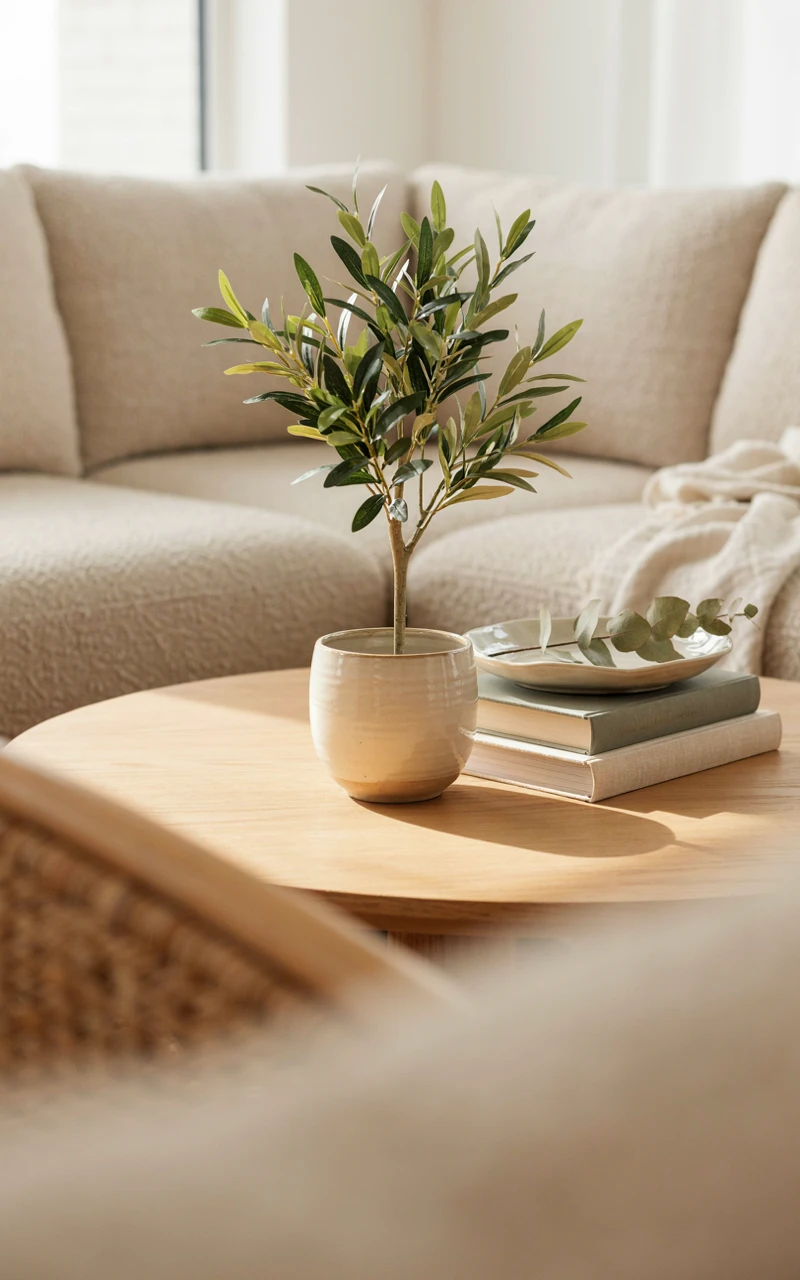
Not every living room has room for a big tree. A small tabletop olive tree gives you the same look in a much smaller size, and it’s the easiest way to try olive tree indoor decor before you commit to a big one.
For a coffee table, look for a tree between 12 and 18 inches (30 to 45 cm) tall. That’s tall enough to look like a real little tree but short enough that you can still see the person across from you on the sofa.
A few ways to make it look good on the table:
- Plant it in a low, wide pot or a shallow stone bowl so it feels grounded and not top-heavy.
- Set it on a wooden or rattan tray with a candle and a small stack of books.
- Place it slightly off-center rather than in the dead middle of the table. It looks more relaxed that way.
- Keep a coaster or small saucer under the pot so watering never leaves a ring on the wood.
Here’s the honest part: the middle of a living room usually doesn’t get enough sun for a real olive tree to stay healthy. I solve this by moving mine to the windowsill for four or five days a week and bringing it back to the coffee table when I have friends over. A small tree is light enough that this takes ten seconds.
Small trees also dry out faster because their pots hold less soil. Check the soil every few days, and water when the top inch (2.5 cm) feels dry.
Key takeaway: A tabletop olive tree brings the look to any size of living room. Just give it regular trips to the window.
7. Choose a Faux Olive Tree for a Low-Light Room
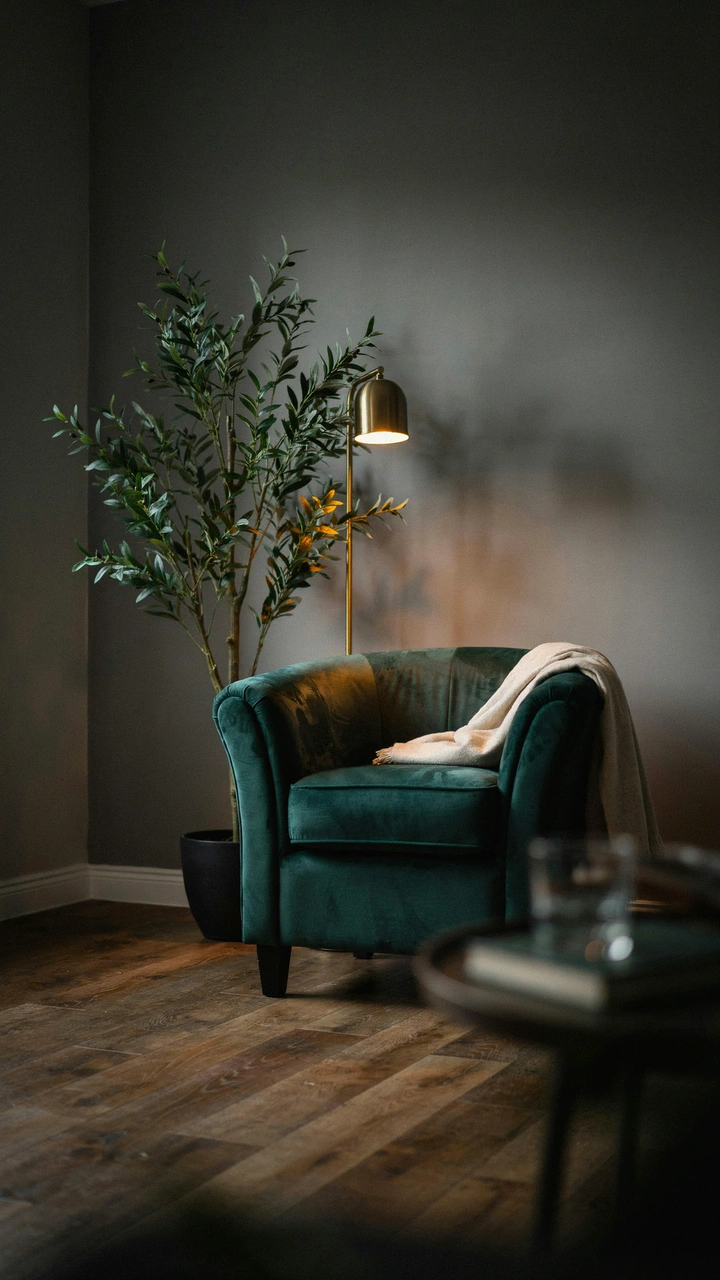
Some living rooms just don’t get enough sun, and that’s okay. A good faux olive tree gives you the same fresh and natural look with zero watering and no dropped leaves.
Faux trees have come a long way. The good ones can fool most guests, but the cheap ones look plastic from across the room. Here’s what to look for when you shop:
- A real wood trunk. Many better faux trees use real branches with fake leaves attached. The bark makes a huge difference up close.
- Matte leaves. Shiny leaves are a giveaway. Real olive leaves are dull green on top and silvery underneath.
- Mixed leaf colors. Look for a blend of sage, gray-green, and deeper green rather than one flat shade.
- Bendable branches. Wired branches let you shape the tree so it doesn’t look stiff.
- Little fruit, used lightly. A few small olives look sweet. A tree loaded with them looks fake.
When it arrives, spend ten minutes fluffing it. Pull the branches apart, bend some up and some out, and turn the leaves so they face different ways. Then drop it into a real pot and cover the base with sheet moss or small pebbles so the plastic stand doesn’t show.
Faux trees still need a little care. Dust collects on the leaves, so wipe them with a damp cloth or use a hair dryer on the cool setting about once a month. If you love leafy greens all over your home, my post on the green aesthetic has more ideas for mixing faux plants with real ones.
Key takeaway: In a dim room, a well-chosen faux olive tree beats a real one that’s struggling.
8. Display Cut Olive Branches on the Console Table
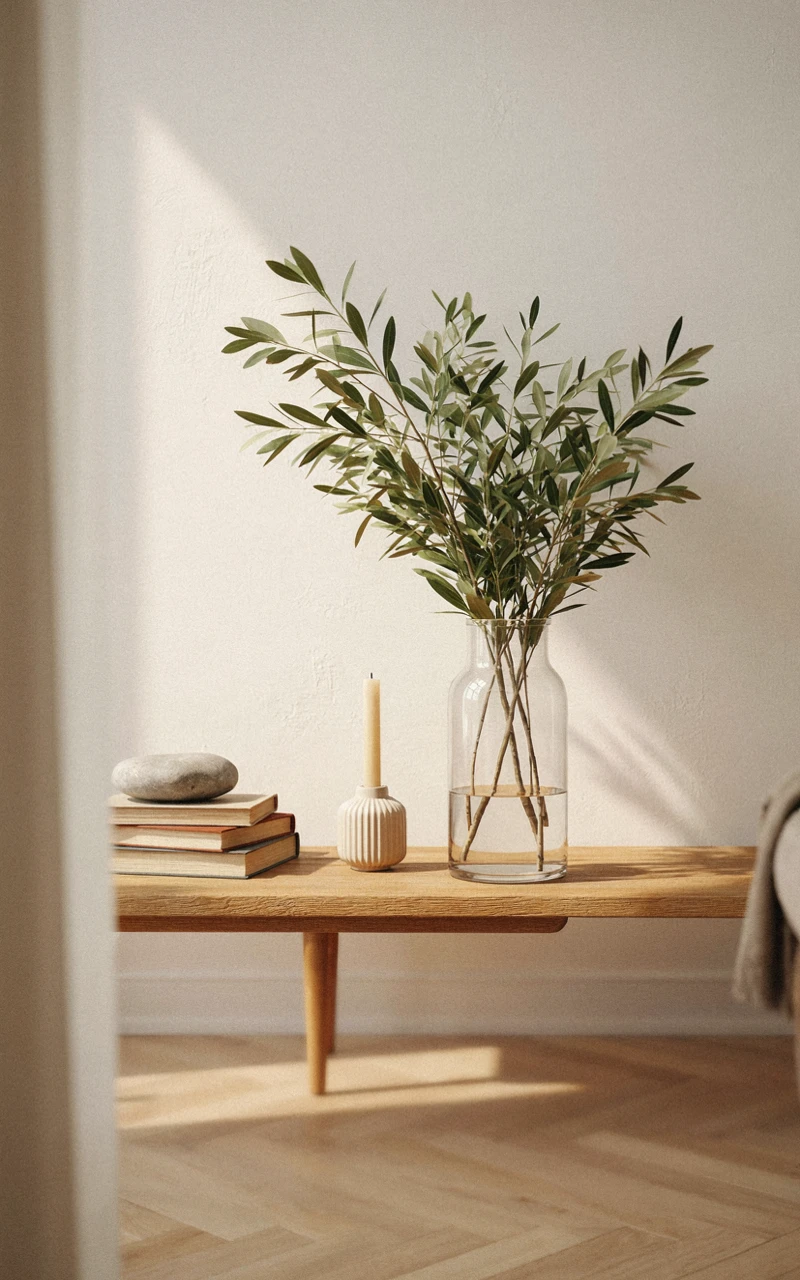
You don’t need a whole tree to bring olive leaves into your living room. A few cut olive branches in a tall vase on a console table give you that same silvery green with almost no effort.
You can find cut olive branches at many florists, flower markets, and online flower shops. You’ll usually see two kinds: fresh branches, which last one to two weeks in water, and dried or preserved branches, which last for months with no water at all.
Here’s how to make fresh branches last as long as possible:
- Trim about 1 inch (2.5 cm) off the bottom of each stem at an angle with sharp pruners.
- Strip off any leaves that would sit below the waterline.
- Fill the vase with cool water, about a third of the way up.
- Change the water every two to three days and re-trim the stems each time.
- Keep the vase out of hot, direct sun, which wilts cut branches faster.
For the vase itself, go tall and simple. A good rule is that the branches should be about one and a half to two times the height of the vase. A stoneware jug, a clear glass bottle, or a ribbed ceramic vase all look lovely with olive branches.
Once the vase is on the console, add one or two other things and stop there. A table lamp, a small stack of books, or a bowl for your keys is plenty. Let the branches be the tallest thing on the table so they catch the eye as you walk past.
Key takeaway: Cut olive branches are a cheap, easy way to get the look, and they work in rooms where a full tree won’t fit.
9. Light Up Your Olive Tree With a Lamp at Night
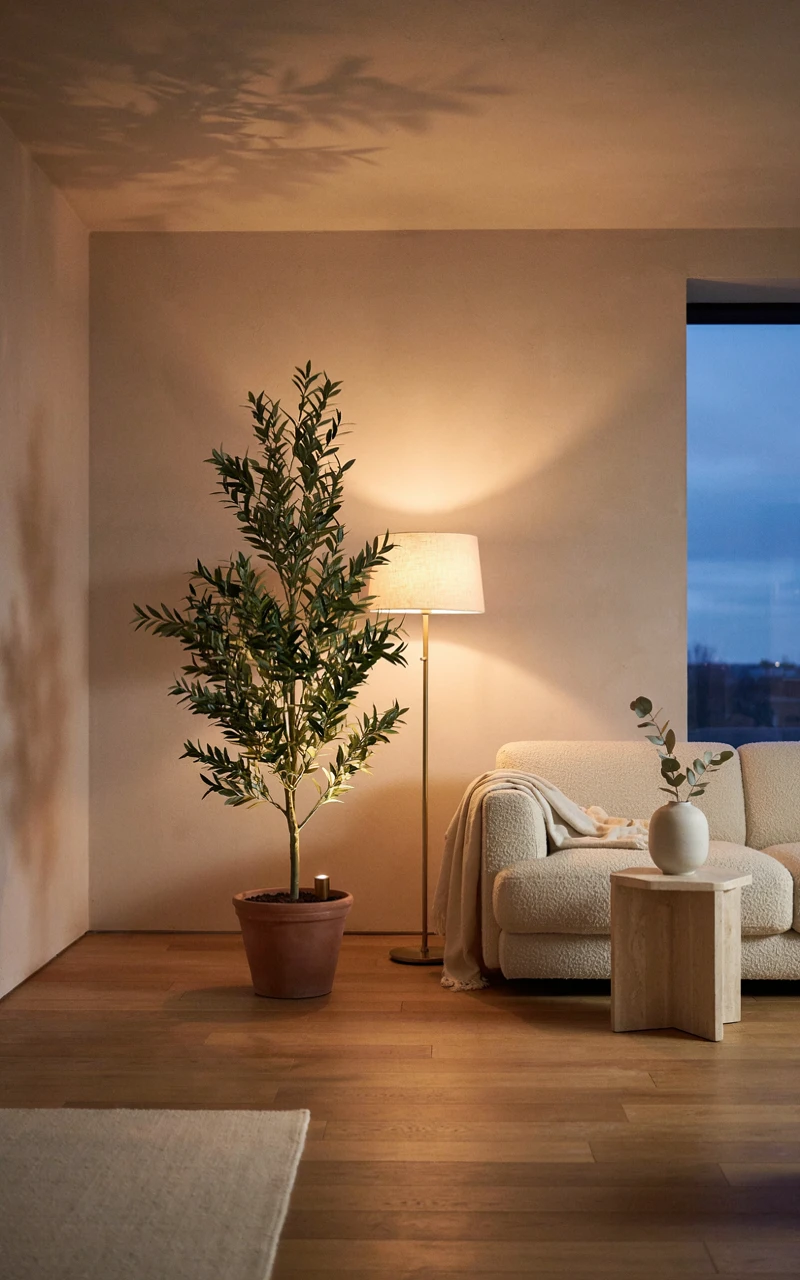
Your olive tree looks great in the daytime, but it can disappear once the sun goes down. A little light at night brings it back and makes the whole living room feel warmer in the evening.
The easiest option is a small uplight, which is a little lamp that sits on the floor and shines upward. Tuck it behind the pot or right beside it, and it will throw soft leaf shadows across the wall and ceiling. It’s one of my favorite parts of having an olive tree in the living room, especially on winter nights.
A few tips for getting the lighting right:
- Pick a warm bulb, around 2700K, which gives a soft, golden glow rather than a harsh blue-white.
- Choose an LED bulb so it stays cool and won’t scorch the leaves.
- Plug it into a smart plug or timer so it turns on at sunset without you thinking about it.
- Move the light a few inches at a time until you like the shadows on the wall.
A real olive tree can also use a different kind of light. In winter, when days are short, a full-spectrum grow light helps it get the light it’s missing. Clip-on grow lights and grow bulbs that screw into a normal lamp both work. Set the timer for about 12 hours a day from November through February, and keep the light 12 to 18 inches (30 to 45 cm) above the top leaves.
Some grow bulbs give off a pink or purple glow, which can look odd in a living room. Look for “full-spectrum” or “white” grow bulbs, which look like normal daylight.
Key takeaway: A warm uplight makes your olive tree shine at night, and a grow light keeps a real one healthy through winter.
10. Repeat Olive Green in Your Pillows and Throws
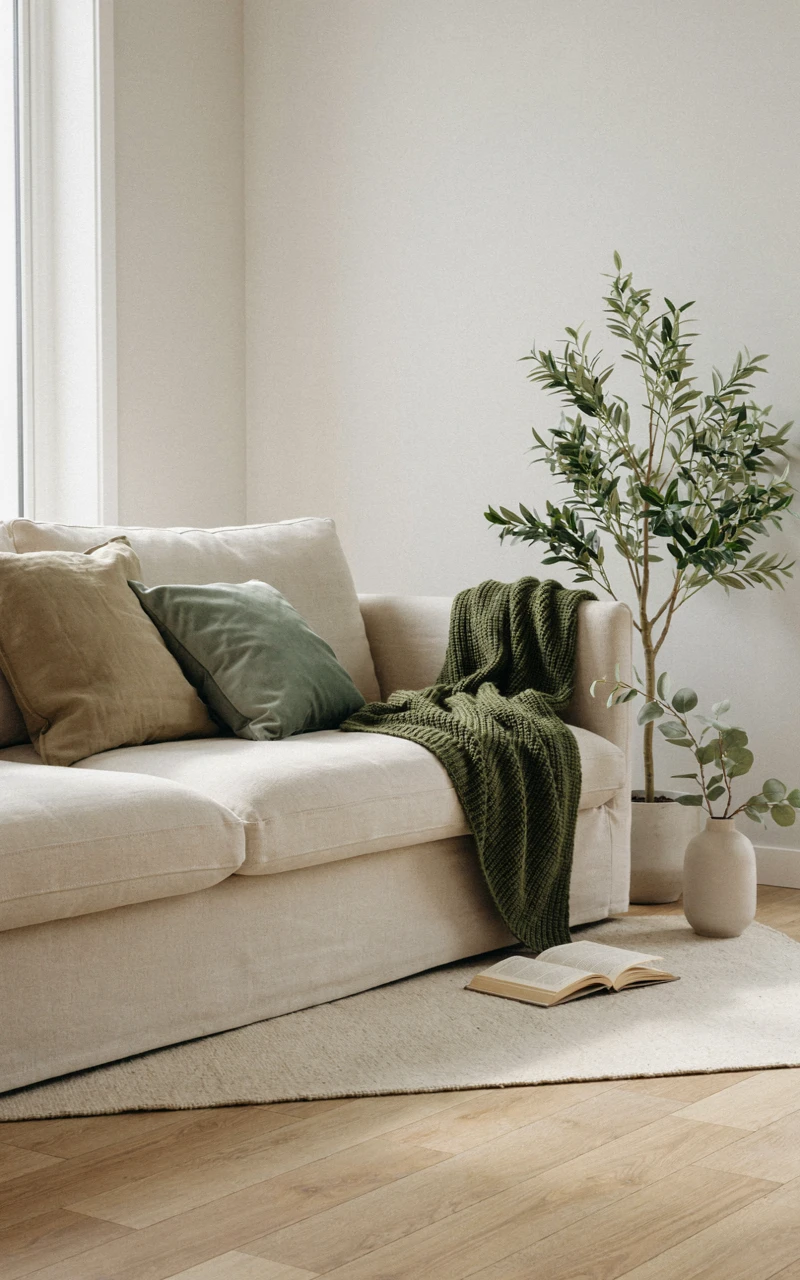
Once you have an olive tree, the easiest way to make your living room feel pulled together is to repeat its color. Picking up that soft gray-green in your pillows and throws ties the tree into the rest of the room, so it looks like it belongs there and wasn’t just dropped in.
Olive trees have more than one green in them. Look closely and you’ll see a silvery sage on the backs of the leaves, a darker olive on top, and a warm brown in the trunk. You can borrow all three.
Here are some easy ways to bring those colors in:
- Pillows: Try two olive green pillows and one in cream or sand on the sofa.
- Throw blanket: A sage linen or wool throw draped over the arm of a chair adds color without being loud.
- Rug: A rug with a thin olive stripe or a muted green pattern connects the floor to the tree.
- Small things: A green ceramic vase, a picture frame, or even a book with a green cover counts.
A good rule is to repeat the color at least three times around the living room. Put one pillow near the tree, a throw across the room, and a vase on a shelf. Your eye will bounce between them, and the room will feel calm and planned.
Different fabrics show green in different ways. Velvet makes olive look rich and deep, linen makes it look soft and faded, and chunky knit makes it look cozy. If you love this color, the green aesthetic is a fun one to explore beyond the living room, too.
Key takeaway: Repeating olive green in a few pillows and throws makes your tree look like part of the room instead of an afterthought.
11. Pair Your Olive Tree With Wood and Stone
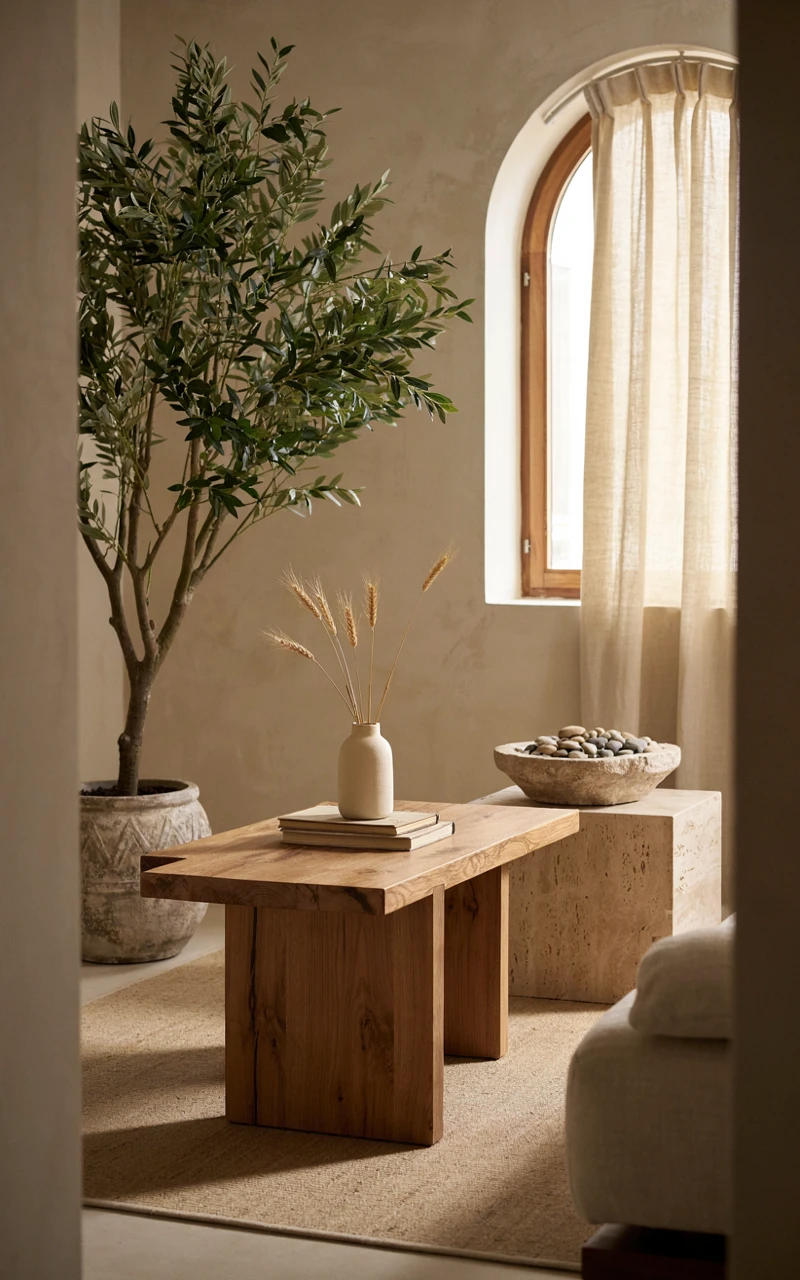
Olive trees grow in rocky hills under bright sun, so it makes sense that they look their best next to wood and stone. These materials bring out the tree’s earthy side and give your living room that relaxed, sun-warmed feel.
You don’t have to buy all new furniture to get this look. Even one or two pieces near the tree make a big difference. Here are some pairings that work well:
| Piece | Wood or stone idea | Why it works |
|---|---|---|
| Coffee table | Travertine, marble, or light oak | Soft, natural colors that sit well next to gray-green leaves |
| Side table | A chunky wooden stool or tree-stump table | Echoes the olive tree’s trunk |
| Pot | Stone, concrete, or carved wood | Grounds the tree with a heavy, earthy base |
| Shelf decor | Wooden bowls, stone coasters, river rocks in a dish | Small touches that repeat the look around the room |
| Floor | Jute or wool rug in sand or oatmeal | Warms up the floor without competing with the tree |
Try to mix light and dark wood rather than matching everything. A pale oak coffee table and a darker walnut side table look more natural together than a perfect set does. The same goes for stone, where a little variation in color looks real and lived-in.
Keep shiny chrome, high-gloss plastic, and bright neon colors to a minimum near the tree. They pull attention away from the soft leaves. If you want a little sparkle, warm brass or aged bronze sits much more comfortably next to olive trees than cool silver does.
Key takeaway: Wood and stone bring out the earthy side of your olive tree and make the whole living room feel warm and grounded.
When I think back to that first tree I lost in a dark corner, I’m glad I didn’t give up. Learning what an olive tree needs taught me that a little sun, a good pot, and a few green pillows can change how a whole living room feels.
You don’t have to try all 11 ideas at once. Start with one, like a sunny window or a small tree on the coffee table, and add more as you go.
You have everything you need to make it work, and I’d love to hear how it goes. Leave a comment and tell me which idea you’re trying first, or where your olive tree has found its happy spot.