This post may contain affiliate links, which means I may receive a small commission should you decide to click that link and make a purchase. For more information please refer to the Terms & Conditions.
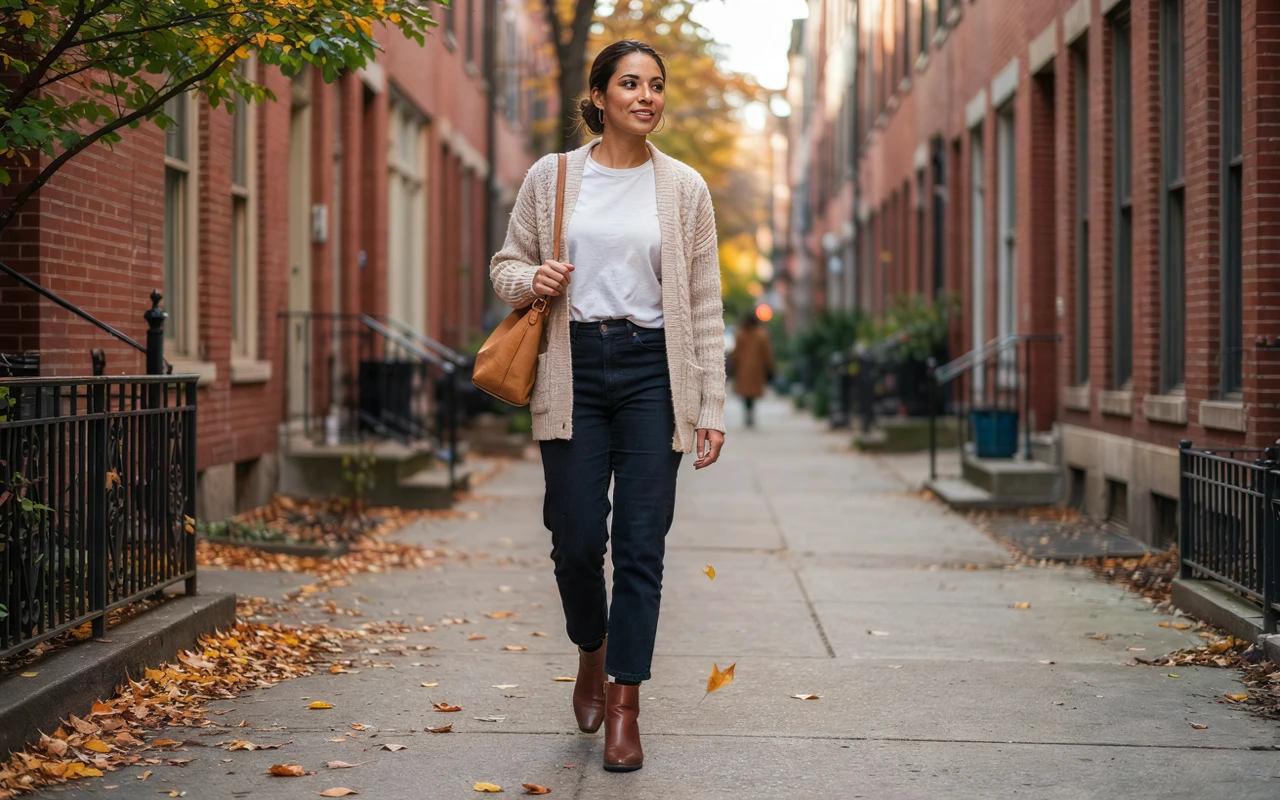
Every September I used to feel the pull to buy a whole new wardrobe. Then one cold morning, running late, I threw a brown cardigan over a white tee and my oldest jeans, and it hit me that learning how to style a fall outfit with basics you already own is mostly about seeing your closet a little differently.
That outfit got more compliments than anything I’d bought that year. So I stopped shopping in a panic and started shopping my own closet instead.
Since then, I’ve spent every fall testing the same handful of pieces in new ways. Some combinations flopped, and a few became the outfits I reach for every single week.
The biggest change was my mornings. I stopped staring at a full closet saying I had nothing to wear, and getting dressed started taking about five minutes.
Below, you’ll find easy ways to put together a fall outfit from the basics already hanging in your closet, without buying a whole new wardrobe.
What You Need: The Basics Already in Your Closet
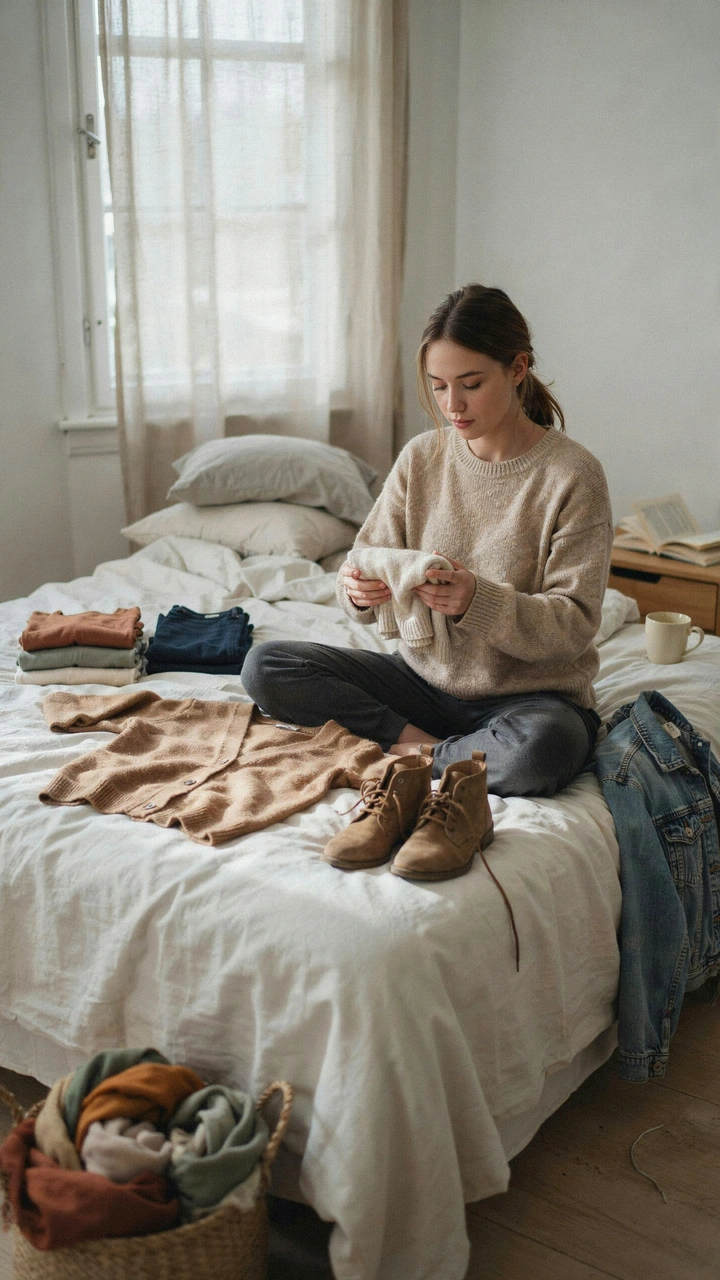
Before you start, it helps to know what counts as a basic. A basic is a plain, simple piece that goes with almost everything else you own.
You don’t need every item on this list. Most people already have six or seven of them, and that’s plenty to build a full week of fall outfits.
The Clothes
- 2 or 3 plain tops: a white tee, a black or gray long-sleeve tee, and a striped top if you have one.
- 1 button-down shirt: white, chambray, or denim all work.
- 1 or 2 sweaters: a crewneck or V-neck in cream, gray, camel, or navy.
- 1 cardigan: any length, though a hip-length one is the easiest to wear.
- 1 pair of blue jeans: straight-leg or slim jeans in a medium or dark wash.
- 1 pair of dark pants: black trousers, black jeans, or thick leggings.
- 1 dress or skirt: a knit dress, a midi skirt, or a denim skirt.
- 1 jacket: a denim jacket, a blazer, a trench coat, or a utility jacket.
The Shoes and Extras
- 2 pairs of shoes: white sneakers plus either ankle boots or loafers.
- 1 belt: brown or black leather, about 1 inch (2.5 cm) wide.
- 1 scarf: a big blanket scarf or a lighter printed one.
- 1 everyday bag: a tote or a crossbody in brown, black, or tan.
- Simple jewelry: small gold or silver hoops, a watch, or a thin necklace.
The Tools for Sorting
- A full-length mirror, or a door mirror propped against the wall.
- Your phone, for taking quick outfit photos.
- Three laundry baskets or bags, one each for “keep,” “maybe,” and “fix.”
- A note on your phone for writing down what’s missing.
- About 45 minutes of free time, ideally in daylight.
Daylight matters more than you’d think. Colors like olive and navy can look almost the same under a yellow bedroom lamp, so a morning by the window makes sorting much easier.
If your closet looks different from this list, that’s completely fine. Maybe you live in leggings and hoodies, or maybe you wear dresses most days. The steps below still work, because they’re about how pieces go together, not about owning a perfect set.
Quick takeaway: you probably own enough already. A few plain tops, one good pair of jeans, a sweater, a jacket, and two pairs of shoes can carry you through most of fall.
Step 1: Sort Your Basics and Spot the Gaps
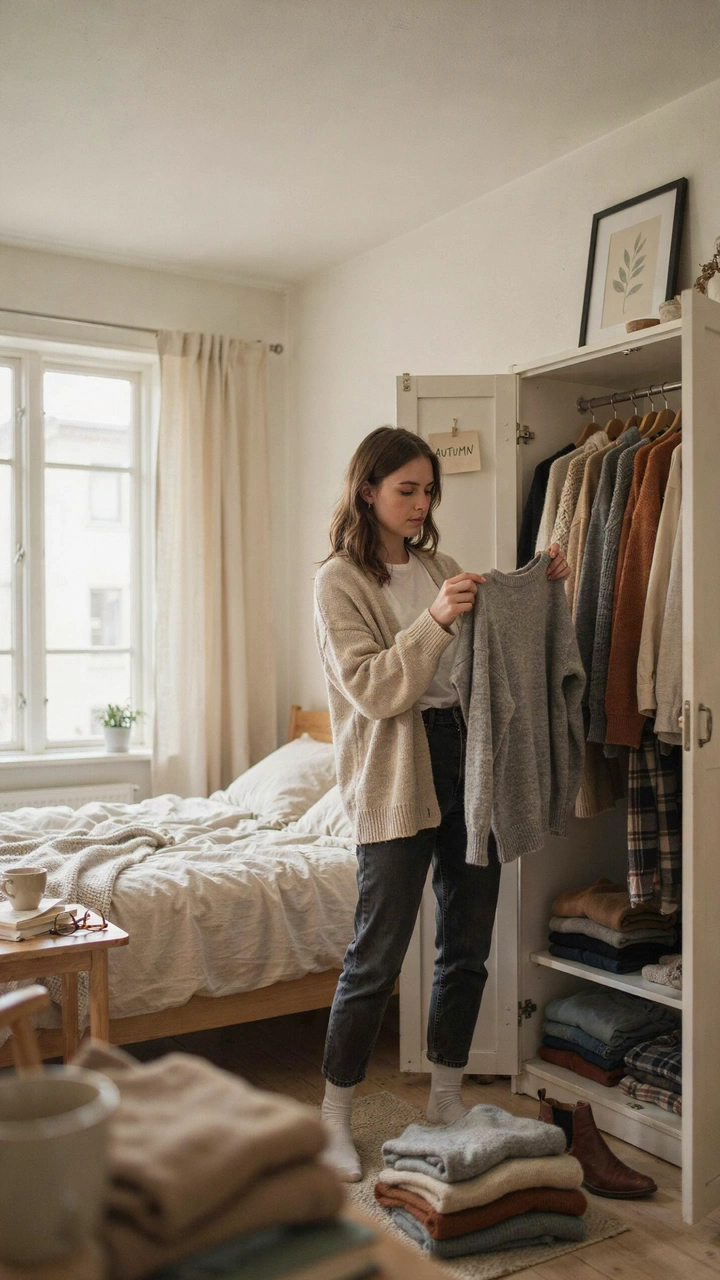
This is the step most people want to skip, and it’s the one that makes everything else easy. When you know exactly what you have, you stop buying a fourth black sweater by accident.
Set aside about 45 minutes. Put on some music, grab your three baskets, and follow these steps in order.
- Pull every top, sweater, pair of pants, skirt, dress, and jacket out of your closet and lay it on the bed.
- Pick up one piece at a time and ask yourself if you’d happily wear it this month.
- Put every piece you love and wear into the “keep” basket.
- Put anything that’s stained, missing a button, or has a fallen hem into the “fix” basket.
- Put anything you’re unsure about into the “maybe” basket.
- Try on each “maybe” piece with your favorite jeans in front of the mirror.
- Move each “maybe” piece to “keep” if it fits and feels good, or set it aside to donate if it doesn’t.
- Hang your “keep” pieces back up, grouped by type: tops together, sweaters together, bottoms together.
- Write down any gaps in the note on your phone.
How to Spot a Real Gap
A real gap is a missing piece that would connect lots of things you already own. If you have five tops and only one pair of pants that fits, those pants are a gap.
Here’s a simple test I use. Before you add anything to your list, name three outfits it would make with clothes already in your closet. If you can’t name three, it’s not a gap, it’s just something nice to look at in a store.
Common gaps I see in fall closets include:
- No warm layer that isn’t a heavy winter coat.
- Only one pair of shoes that works with socks.
- Lots of bright summer tops but no plain long-sleeve tee.
- Jeans that only fit when worn with sandals because they’re too short or too long.
While you’re sorting, glance at the care labels on your sweaters. In the US, the FTC’s Care Labeling Rule requires clothing to carry washing instructions, so that tag tells you whether a sweater needs a cold wash, a hand wash, or a dry cleaner.
Shopping your own closet is also kinder to the planet. The EPA’s textile data shows that millions of tons of clothing and other fabrics end up in landfills in the US every year, so wearing what you have really does count.
The Finished Look: your closet holds only pieces you’d actually wear this fall, grouped by type so you can see everything at a glance. You have a short gap list with one to three items on it, and a “fix” basket ready for a quick mending session or a trip to the tailor.
Step 2: Choose Fall Colors That Tie Your Basics Together
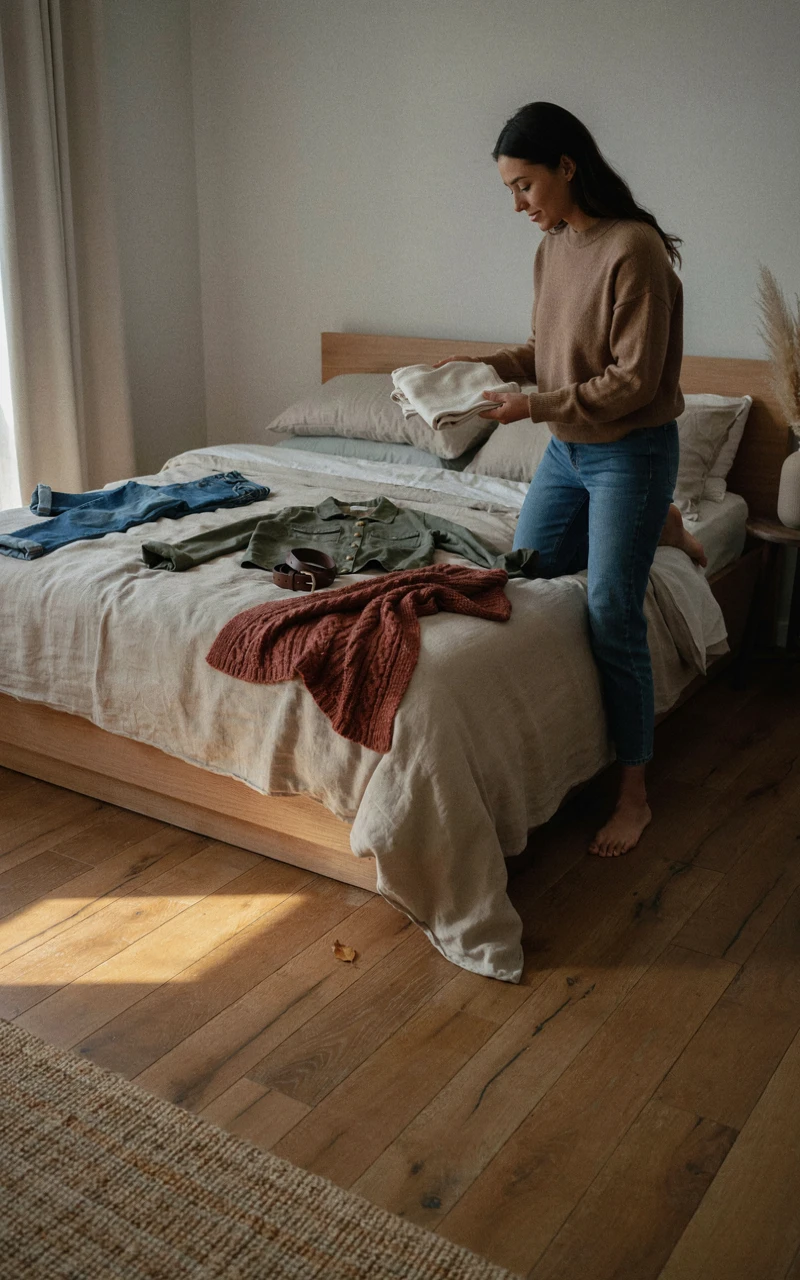
Color is what makes a plain outfit feel like fall. The same white tee and jeans look like summer with pink sneakers and like autumn with a rust cardigan and brown boots.
The easiest way to make your basics work together is to pick a small color plan. You need two kinds of colors: neutrals for the base and one or two fall colors for warmth.
Your Neutrals
Neutrals are the quiet colors that go with everything. Look at the pieces you just hung back up and notice which neutrals show up most.
- Black and gray
- Navy
- Cream and white
- Camel and tan
- Chocolate brown
- Denim blue
Your Fall Colors
Fall colors bring the warm, cozy feeling people love about fall fashion. You only need one or two of them, often in a sweater, a scarf, or a bag.
- Rust and burnt orange
- Olive green
- Burgundy and wine
- Mustard yellow
- Deep forest green
How to Pick Your Plan
- Count which two or three neutrals you own the most of.
- Look for any fall-colored pieces you already have, even small ones like a scarf or a beanie.
- Hold each fall color under your chin by a window and see which ones make your face look bright and awake.
- Choose one or two fall colors that pass the mirror test.
- Write your plan in your phone note, for example: “cream, denim, brown, plus rust and olive.”
Here are some pairings that work with almost any closet:
| Neutral Base | Fall Color | Easy Outfit Example |
|---|---|---|
| Denim and white | Rust | White tee, blue jeans, rust cardigan, brown ankle boots |
| Black and gray | Burgundy | Gray sweater, black jeans, burgundy scarf, black boots |
| Cream and camel | Olive | Cream sweater, olive pants, camel coat, loafers |
| Navy and white | Mustard | Striped top, navy trousers, mustard sweater over the shoulders |
| Brown and cream | Forest green | Green sweater, cream jeans, brown belt, brown bag |
A simple rule keeps outfits looking calm: two neutrals plus one fall color. Once you get the hang of it, you can try two fall colors together, like olive and rust, which look lovely side by side.
If warm browns are your favorite, they carry over nicely into your face too. A soft brown fall makeup look pairs beautifully with camel, cream, and rust clothes.
The Finished Look: you have a written color plan with two or three neutrals and one or two fall colors. When you look at your hanging clothes, you can see that most of them fit into that plan, and the pieces that don’t are easy to spot.
Step 3: Build Your Base Outfit
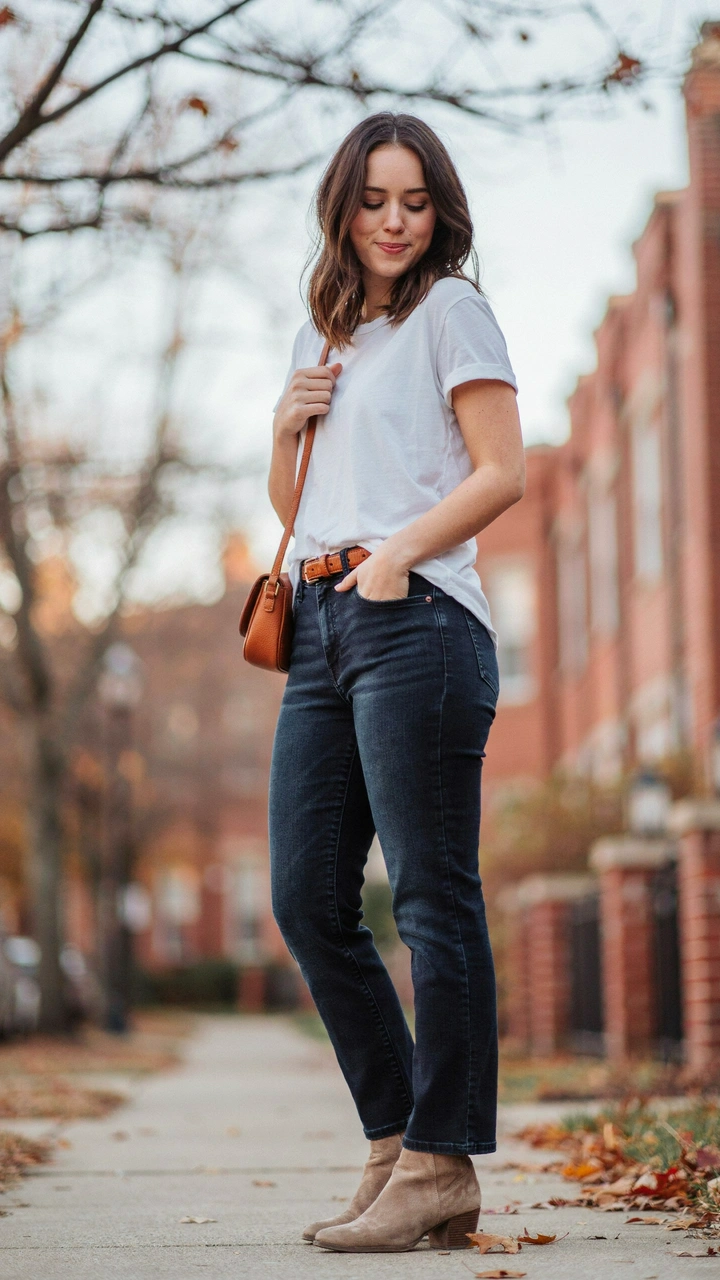
Your base outfit is the simple combination you’d wear on a mild fall day with nothing over it. It’s usually just a top, a bottom, and a pair of shoes.
Getting this part right means every layer and accessory you add later has something solid to sit on. These are the casual outfits you’ll wear most often, so they should feel comfortable first and stylish second.
The Simple Base Formula
Start with the bottom, then choose a top, then think about shape. That order works because pants and skirts are harder to change than tops.
- Choose your bottom: jeans, dark pants, a skirt, or a dress.
- Choose a top in one of your neutrals.
- Check the shape in the mirror: pair a loose top with fitted pants, or a fitted top with wider pants.
- Tuck the front of your top into your waistband if it’s loose, leaving the back out.
- Add your belt if your top is tucked.
- Cuff your jeans once or twice, about 1 to 2 inches (2.5 to 5 cm), if you plan to wear ankle boots.
- Put on your shoes and check the full outfit in the mirror.
Why the Shape Check Matters
The shape check is the step that makes basics look put together. A loose sweater with loose jeans can look a little sloppy, while the same sweater with slim jeans looks relaxed on purpose.
The half-tuck in step four does a lot of work too. It shows your waist, lets the top fall nicely, and makes plain pieces look styled in about two seconds.
Three Base Outfits to Try
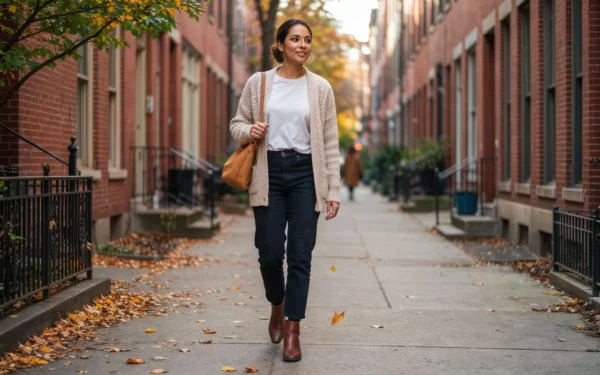
- The classic: white tee, blue straight-leg jeans, half-tuck, brown belt, white sneakers.
- The polished one: button-down shirt, black trousers, front tucked in, loafers.
- The easy dress: knit dress, thick black tights, ankle boots.
If you’re between sizes on a top, try it backward or knot it at the side. A long tee knotted at the hip works just like a half-tuck with high-waisted jeans.
Don’t worry if your base outfit looks plain right now. That’s exactly the point, because it’s meant to be the quiet starting point for the next three steps.
Quick takeaway: bottom first, top second, shape check third. If the base feels comfy and fits well, everything you add on top will look good too.
The Finished Look: you’re wearing a simple, comfortable outfit where the top and bottom balance each other, one loose and one fitted. Your top is half-tucked or knotted, your pants hit at the right spot above your shoes, and you’d happily walk out the door in it on a sunny 68°F (20°C) afternoon.
Step 4: Add a Layer for Cooler Days
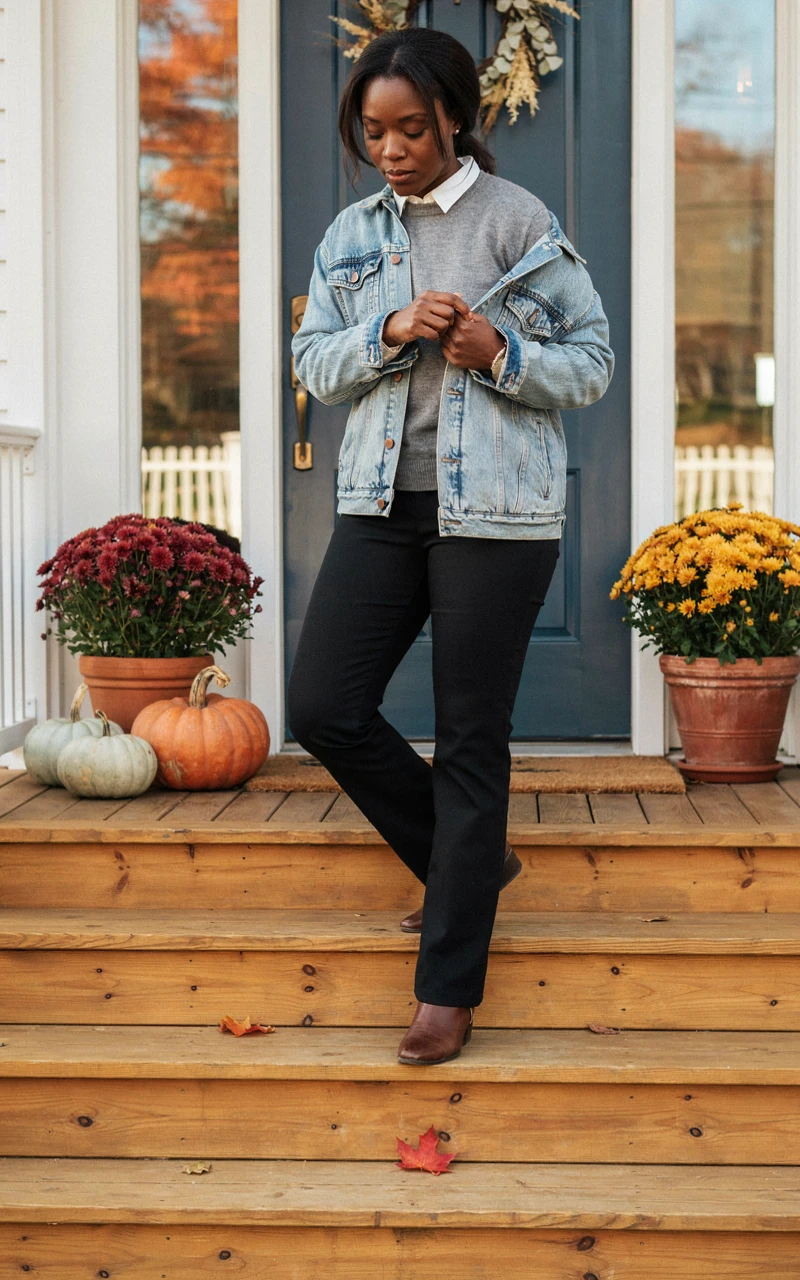
Layering is the heart of fall dressing. Mornings can be chilly, afternoons warm, and evenings cold again, so wearing layers lets you add or remove pieces as the day changes.
The simple rule I follow is that each layer gets a little heavier and a little longer as you move outward. A thin tee goes under a sweater, and a sweater goes under a jacket.
What to Wear by Temperature
Checking the weather before you get dressed saves so much shivering. Here’s a rough guide I use every fall morning.
| Temperature | What to Add to Your Base Outfit |
|---|---|
| Above 65°F (18°C) | Nothing, or a light cardigan or shirt tied over your shoulders |
| 55 to 65°F (13 to 18°C) | A cardigan, a denim jacket, or a button-down worn open |
| 45 to 55°F (7 to 13°C) | A sweater plus a jacket, blazer, or trench coat |
| Below 45°F (7°C) | A sweater, a warm coat, and a scarf |
How to Add Your Layer
- Check the morning temperature and the high for the day.
- Choose one layer from the table above that matches the morning temperature.
- Pick a layer in a different shade from your top, so the two don’t blend together.
- Put the layer on and look at where it ends: just below the hips or at mid-thigh usually works best over pants.
- Push the sleeves up slightly to show your wrists if the layer is a sweater or cardigan.
- Leave jackets and cardigans open unless it’s truly cold.
- Add a scarf if the morning is below 50°F (10°C).
Layering Tricks That Use What You Have
A button-down shirt makes a great light jacket. Wear it open over a tee with the sleeves rolled to the elbow, and you’ve got a whole new outfit without buying anything.
You can also layer a shirt under a sweater. Let the collar peek out at the neck and a little of the hem show at the bottom, about 1 inch (2.5 cm), and a plain crewneck suddenly looks more put together.
If you love that classic camel-coat-over-cream-knit look, my post on old money fall outfits shows lots of ways to wear it with simple basics. Most of those outfits start with exactly the pieces from this list.
One thing to avoid is stacking three thick layers. A chunky sweater under a puffy jacket under a blanket scarf can feel bulky, so keep at least one of your layers thin.
The Finished Look: your base outfit now has one or two layers that suit the day’s temperature. The outer layer is longer than the one underneath, the colors are different enough to see each piece, and you can take the top layer off at lunch and still look dressed.
Step 5: Swap in Fall Shoes, Bags, and Accessories
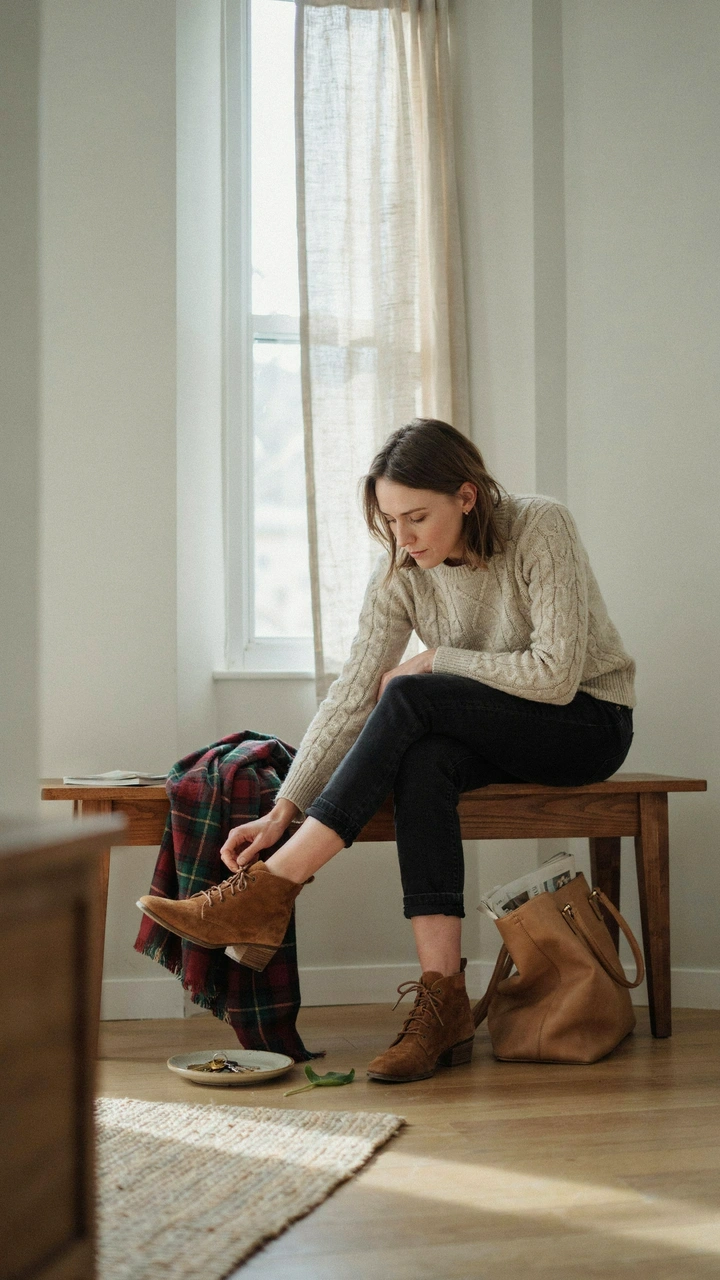
Accessories are where the same outfit can look three completely different ways. They’re also the fastest way to make summer basics feel like fall.
Think of this step as changing the frame around the picture. The jeans and sweater stay the same, but the shoes, bag, and jewelry set the mood.
Fall Shoes
Swapping sandals for closed shoes is the single biggest signal that your outfit is a fall outfit. Here’s what works with which bottoms.
- Ankle boots: great with cuffed jeans, dresses with tights, and midi skirts.
- Loafers: lovely with trousers, straight jeans, and a pair of fun socks.
- White sneakers: perfect for weekends and errands with almost anything.
- Tall boots: made for knit dresses and skinny jeans if you have a pair.
Fall Bags
Brown, tan, and cognac bags look warm and seasonal, while black always works. Suede and leather feel more like fall than straw or bright canvas.
A roomy tote is great for work days, and a small cross body is easier for weekends. If you only own one bag, a brown leather tote covers almost every outfit in this guide.
Accessories
- A scarf in one of your fall colors.
- Small gold hoops or studs.
- A brown leather belt.
- A felt hat or a knit beanie for colder days.
- A simple watch.
How to Swap Your Accessories
- Choose shoes that match the color of your belt or bag, like brown boots with a brown bag.
- Pick one main accessory to stand out, such as a printed scarf or a bold earring.
- Keep every other accessory small and simple.
- Check that your shoes work with your pant length: cropped pants with boots, full-length pants with loafers or sneakers.
- Take a quick photo of the outfit in the mirror.
- Look at the photo and remove one accessory if it feels busy.
That photo trick from the last two steps really helps. Things you don’t notice in the mirror often jump out in a picture.
Your hair and nails count too. A low twist or a quick braid from my easy fall hairstyles post looks lovely with a big scarf, because it keeps your hair from getting tangled in it.
Quick takeaway: one standout accessory per outfit. Let the scarf shine or let the earrings shine, but not both at once.
The Finished Look: your outfit wears closed fall shoes, a bag in a warm or dark color, and one accessory that draws the eye. When you look at your photo, nothing feels crowded, and the shoes and bag look like they belong together.
Step 6: Mix and Match Your Basics Into a Week of Fall Outfits
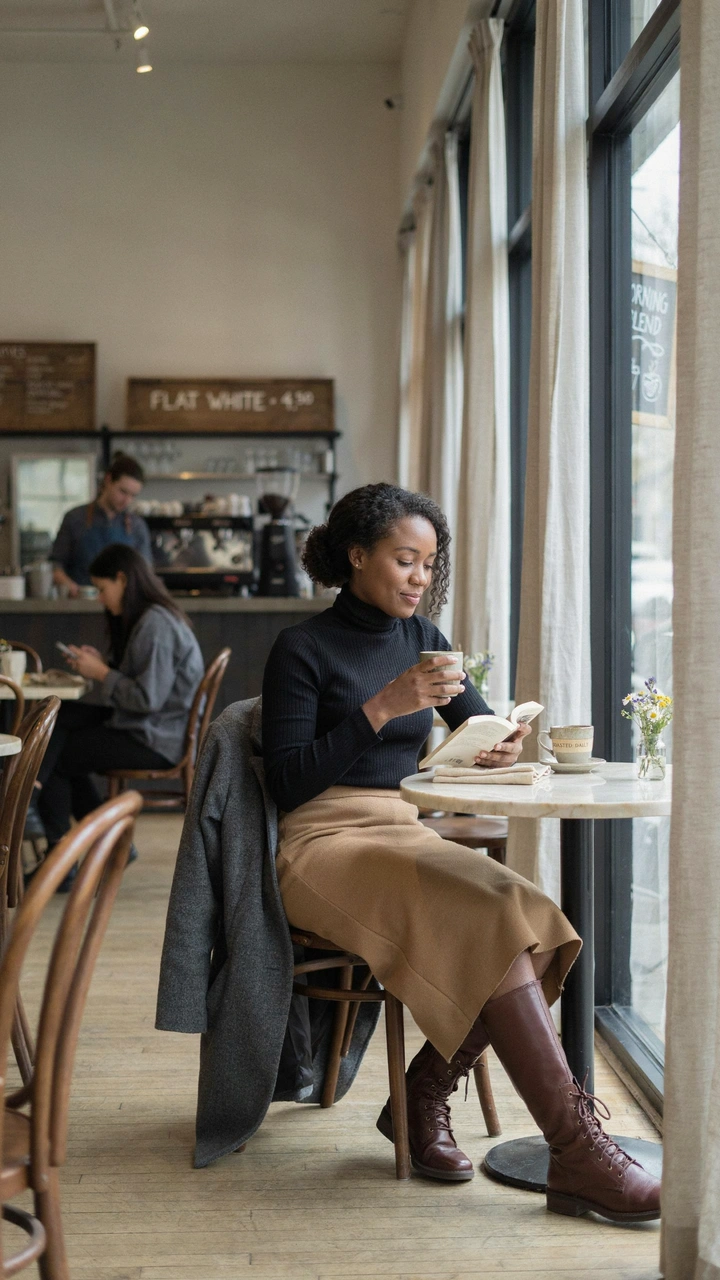
This is where all the earlier steps come together. With about ten basics, you can plan a full week of different fall outfits and never feel like you’re repeating yourself.
The trick is to change at least two parts of the outfit each day. Swap the top and the layer, or the bottom and the shoes, and the outfit looks new.
How to Plan Your Week
- Set a 15-minute timer on Sunday afternoon.
- Check the weekly weather forecast on your phone.
- Write down what each day holds, like work, school pickup, dinner out, or a lazy weekend.
- Pick a bottom for each day first, using each pair of pants no more than twice.
- Add a top and a layer for each day based on the temperature.
- Choose shoes and one accessory for each outfit.
- Hang each full outfit together on one hanger, or snap a photo and save it to an album.
A Sample Week From 10 Basics
Here’s a real week built only from a white tee, a striped top, a button-down shirt, a cream sweater, a rust cardigan, blue jeans, black trousers, a knit dress, a denim jacket, and a camel coat. Shoes and accessories rotate between ankle boots, loafers, sneakers, a scarf, and a brown belt.
| Day | Outfit |
|---|---|
| Monday | Button-down, black trousers, cream sweater over the shoulders, loafers |
| Tuesday | White tee, blue jeans, rust cardigan, ankle boots, brown belt |
| Wednesday | Knit dress, black tights, denim jacket, ankle boots |
| Thursday | Cream sweater, black trousers, camel coat, loafers, scarf |
| Friday | Striped top, blue jeans, camel coat, white sneakers |
| Saturday | White tee, blue jeans, button-down worn open, white sneakers |
| Sunday | Knit dress, rust cardigan, belt at the waist, ankle boots |
Look closely and you’ll see the blue jeans show up three times. Nobody notices, because the top, layer, and shoes change each time.
Keep the Ideas Coming
Your own photos become your best outfit inspiration. After a few weeks, scroll back through the album and repeat the outfits you felt great in.
When you get bored, try one small twist. Wear your cardigan buttoned up as a top, tuck a sweater into a skirt, or put a belt over your coat, and autumn outfits you’ve worn before feel fresh again.
Key takeaways for your week:
- Plan on Sunday in 15 minutes so weekday mornings take 5.
- Change at least two parts of each outfit from the day before.
- Let your jeans and plain tops do most of the work.
- Save photos of the outfits you love and repeat them.
The Finished Look: you have seven outfits planned, each one hung up or saved as a photo. Every outfit uses your color plan, has a layer that suits the forecast, and feels different from the day before, even though they all come from the same small set of basics.
When I first tried this, I honestly expected to get bored by Wednesday. Instead, I found that wearing fewer pieces made me more creative, and I started noticing combinations I’d walked past for years.
Your closet probably holds far more fall outfits than you think. A tee, a pair of jeans, a sweater, and a good pair of boots can carry you a long way when you know how to put them together.
So pull everything out this weekend, pick your colors, and build that first base outfit. You already have what you need, and I’d love to hear which basic you end up wearing the most, so tell me in the comments below.